Silicone or stone drying mat: What really dries beside the sink
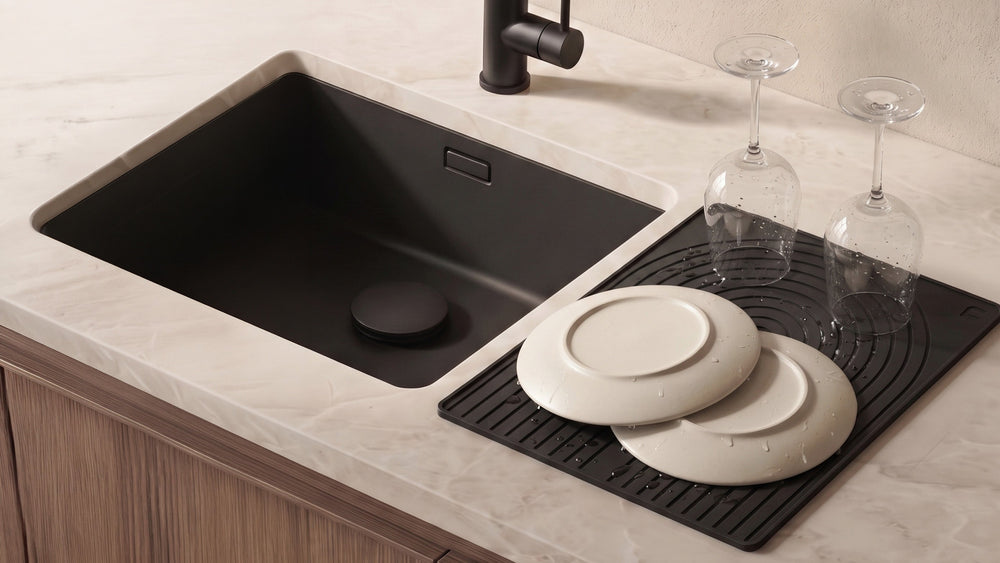
Silicone dries faster; stone dries invisibly. A silicone mat channels water away through raised grooves and is ready to use again immediately after wiping. Diatomaceous stone absorbs water into the material and releases it into the air over several hours—but the surface looks dry while it is still working. Both work. Just not in the same place.
So, when looking for a dish drying mat, you are not choosing between good and bad, but between two principles. The following comparison shows which principle is right for which sink.
Silicone or stone: the real difference
The difference is not in appearance, but in where the water goes.
Silicone is waterproof. The water stays on top and flows where the structure directs it. A good silicone mat therefore has raised grooves: dishes stand on the ridges, air reaches them from below, and water collects in the spaces between. Our 30 × 40 cm mat can thus hold up to 550 ml before anything spills over the edge. That is about one large cup more than a set of washed breakfast dishes brings with it.
Diatomaceous earth—often simply sold as stone or kieselguhr—is porous. The water disappears into the board in seconds and then slowly evaporates outward. The surface feels dry sooner than it actually is.
Fabric and microfiber mats are the third option. They are inexpensive and quiet, but they keep the water exactly where the dishes stand. If you do not replace them daily, you will have a permanently damp surface under the sink.
How quickly does each dry?
If you wash dishes several times a day, silicone wins. Not because it absorbs water better, but because you can actively empty it: tip it, wipe it, and you are done. The mat is immediately ready to absorb water again.
Diatomaceous earth needs this break itself. Once the board is saturated, it no longer absorbs anything and the water sits on top—only without grooves to channel it away. In a sink used morning and evening, this is not noticeable. In a family kitchen, it is.
Fabric loses in both cases because it does not dry, but only redistributes the water.
Dish drying mat for the sink: which size is right
The most common mistake is the size, not the material.
For the strip between the sink and the wall, a narrow mat is sufficient. It absorbs dishwashing liquid, the brush, and the sponge, and keeps the splash zone dry—that is all it needs there. Our narrow version measures 28 × 10 cm, is designed exactly for this purpose, and fits under the sink organizer.
For dishes, glasses, and pots that really need to drip dry after washing, a surface of around 30 × 40 cm is the sensible minimum. Anything smaller fills up too quickly.
Measure the free space next to the sink before buying—not the entire countertop. The space between the edge of the sink and the wall connection is what you can actually cover.
Around the faucet
Water collects behind the faucet where no one wipes it. It runs down the base, pools, and leaves limescale rings on the countertop.
A flat mat that reaches the faucet base catches it. A low profile is important: if the mat is too thick, it presses against the spout when you swivel it. 0.8 cm is low enough not to get in the way.
For this location, silicone is the clearer choice. The surface stays permanently damp instead of getting wet in spots—exactly the case where an absorbent material will never dry out properly again.
Dish drying mat in the bathroom: at the washbasin
In the bathroom, the task is different. It is not about dishes, but about soap dispensers, toothbrush cups, and cream jars that leave damp rings.
Because the surface in the bathroom is rarely ventilated, the same rule applies as with the faucet: a material that stores water will remain damp for a long time in a room with high humidity. A wipeable mat is easier to care for here. How this fits together with the rest of the furnishings is explained in the guide to the Shower shelf without drilling.
What does not work
Three things that regularly go wrong in practice:
Using the mat as permanent storage. If you leave dishes on it overnight, you will have no dry mat in the morning, but a puddle with a rim. Every material needs a phase in which nothing is standing on it.
Stone on a wet countertop. Diatomaceous earth draws water from both sides. If the board stands in a puddle, it becomes saturated from below and never dries on top.
Ignoring limescale. With hard water, limescale settles into every structure. On silicone, it can be removed; on porous stone, it permanently clogs the pores—then sanding is the only solution, and the board gets thinner with every treatment.
Care: what makes the mat last a long time
Silicone is uncomplicated here. Wiping is enough for everyday use; if necessary, the mat can go in the dishwasher. Because our mats are made of food-safe, BPA-free silicone and remain heat-resistant up to 299 °C, a wash cycle is not a risk to the material.
For limescale streaks, use a cloth with a little vinegar water, then wipe clean with clear water. More on the sink routine is explained in the little basics of kitchen cleaning.
Diatomaceous earth is brushed dry, not washed. And it must not go in the dishwasher.
Fabric mats must go in the wash as soon as they smell—which is the point at which they have already been left out for far too long. What to consider when washing them, we have written down for sponge cloths.
Our mats
We at nordesign chose silicone because it is the material that can be reset daily in a kitchen—empty it, wipe it, and you are done. Both formats have the textured surface with the Nordic arch pattern and are available in black, greige, and white.
The 30 × 40 cm dish drying mat is the drying zone for dishes and glasses. The narrow 28 × 10 cm dish drying mat is the base for dishwashing liquid, sponge, and brush, and fits under the organizer.
Over 450,000 customers now trust us.
Frequently asked questions
Is a silicone or stone dish drying mat better? Silicone, if you wash dishes several times a day and the mat needs to be ready to absorb water again quickly. Stone, if the surface should look dry and has time to evaporate between uses.
How large should a dish drying mat for the sink be? Around 30 × 40 cm for dishes and glasses. For the strip next to the sink with dishwashing liquid and sponge, about 28 × 10 cm is sufficient.
Can a dish drying mat go in the dishwasher? Silicone mats, yes. Diatomaceous earth boards, no—they are cleaned dry.
Does a dish drying mat help against limescale stains on the countertop? Yes, because the water no longer reaches the countertop. Limescale will still form on the mat itself with hard water, but it can be wiped off.
Is a dish drying mat also suitable for the bathroom washbasin? Yes, mainly as a base for soap dispensers and cups. In damp rooms, a wipeable material is the easier-to-care-for choice.
If you want to reorganize the entire sink area, you will find the order in our guide to Kitchen organization.
More Home Stories
Soap dispenser no longer pumps: What can be repaired – and what cannot
Shampoo and shower gel dispensers in the shower: what matters when it comes to the pump, holder, and size
Cleaning countertops: What is allowed on which material
Washing kitchen towels: 60 degrees, no fabric softener – and why that’s enough
Wooden Wick Candle Goes Out: What Causes It and What Helps
How to Remove Fish, Onion & Garlic Smells from Your Hands — What Really Works
Clean stainless steel without scratches and streaks